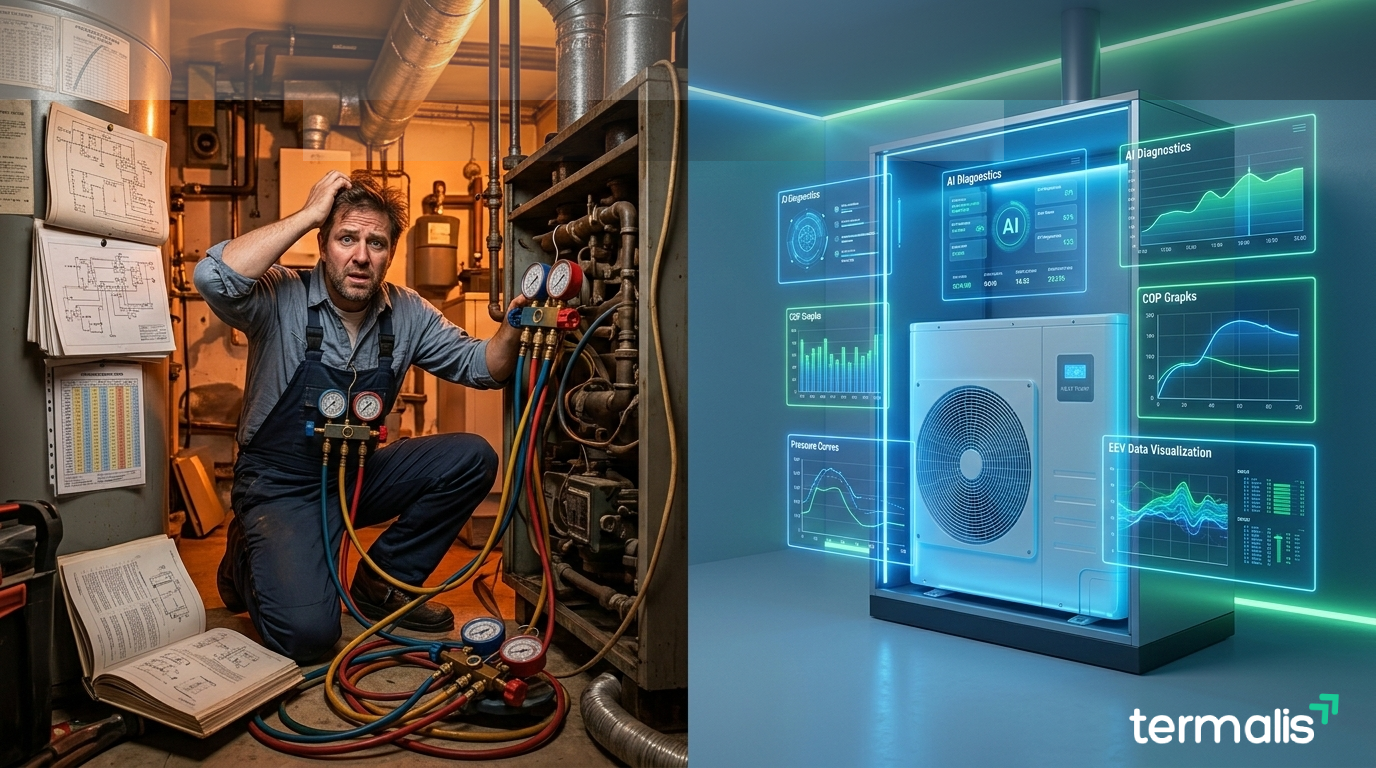
The biggest problem in the heat pump market isn't efficiency. It's service.
Everyone is optimizing COP. Few are optimizing diagnostics.
The heat pump industry has reached impressive efficiency numbers. Manufacturers compete over fractions of COP points. Marketing brochures highlight seasonal performance factors. And yet — when a system underperforms in the field, the response looks exactly the same as it did 15 years ago: send a technician.
Most companies respond to the service challenge by:
- 1 Building internal training academies
- 2 Certifying more technicians
- 3 Investing heavily in training programs
- 4 Hiring more expensive specialists
All of these are valid efforts. But they all share the same assumption: the problem is a lack of skilled people.
But what if that's the wrong direction?
What if we don't need smarter technicians...
What if we need smarter systems?
What a modern heat pump should actually do
Today's heat pumps generate enormous amounts of data — EEV positions, pressures, temperatures, compressor frequencies, flow rates. But in most installations, this data sits unused. The controller reacts to faults, but doesn't understand what's happening.
A truly intelligent system should:
- Analyze EEV, pressure & temperature relationships in real time
- Detect refrigerant charge deviation before it becomes a fault
- Identify heat exchanger fouling from performance degradation
- Calculate COP degradation in % — not just flag a generic error
- Recognize hydraulic imbalance across heating circuits
⚠ Heat exchanger fouling detected
↓ COP down 14%
→ Recommended action: cleaning required
Instead of raw data and cryptic error codes, the system communicates in plain language. The technician doesn't need to spend 2 hours diagnosing. He arrives on site already knowing the problem, the cause, and the solution.
The technician doesn't diagnose. He executes.
That changes everything.
What the next 5 years look like
The heat pump industry is entering a phase of commoditization. Hardware differences between manufacturers are shrinking. The compressors, heat exchangers, and refrigerant circuits are converging toward similar designs.
What will differentiate companies is not what's inside the box — but what happens after installation:
Hardware standardizes
Components converge across brands
Control logic wins
Data interpretation defines leaders
Service automates
Matters more than brochure COP
The companies that will lead the market aren't necessarily those with the best hardware specs. They're the ones that can tell a customer: "Your system efficiency dropped 12% this month. Here's why. Here's what we recommend. Do you want us to schedule it?"
That's not a technician's job. That's a platform's job.
This is what we're building at Termalis
Termalis Control is our AI-powered heat pump management platform that does exactly this — real-time diagnostics, COP optimization, predictive maintenance alerts, and clear actionable recommendations. Not raw data. Not error codes. Answers.
Explore Termalis Control →